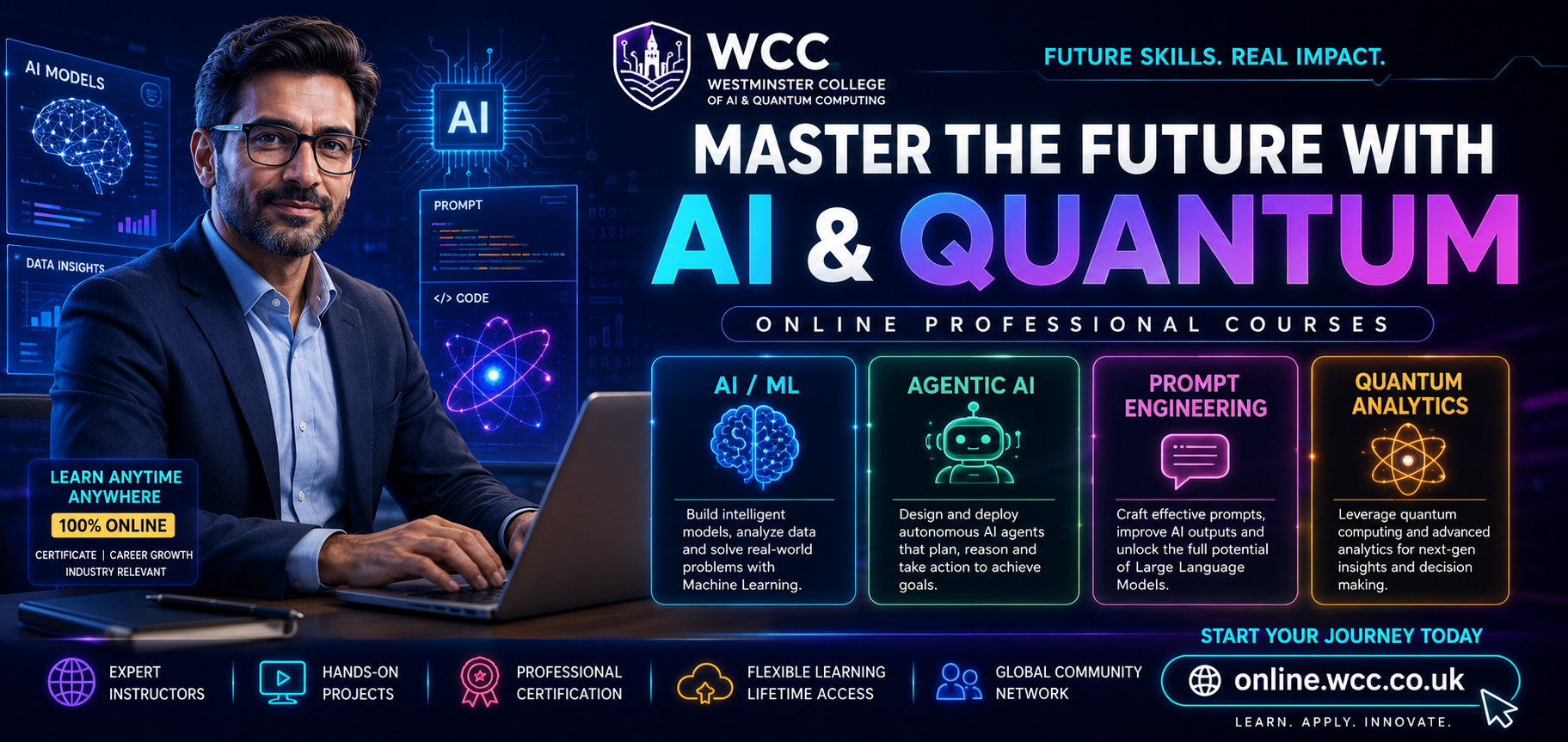
Empowering future innovators with expert guidance, advanced Hands-on IT training, and Innovator Founder mentoring.
We are trusted by some of the UK's most prestigious public-sector organisations, academic institutions, and global technology leaders, including the Ministry of Defence, Passport Office, Home Office, Transport for London (TfL), the University of Oxford, Imperial College London, University College London (UCL), the University of Sheffield, SAP, and Oracle.
Comprehensive programs designed by industry experts to give you the skills needed in today's competitive tech landscape.
Master HTML5, CSS3, JavaScript, React, Node.js and databases. Build responsive UIs with Tailwind/Bootstrap, state management with React hooks, scalable APIs with Express.js, SQL/NoSQL integration, and deploy full-stack apps on cloud platforms (Vercel, Render, AWS).
Dive into neural networks, deep learning, and end-to-end ML pipelines: data prep, training, evaluation, deployment. Cover supervised/unsupervised learning, CNNs, RNNs, Transformers, and model deployment with Gradio/FastAPI.
Explore AGI research, cognitive architectures (ACT‑R, Soar), neural‑symbolic methods, meta‑learning, value alignment and AGI safety. Understand the theoretical foundations and future of human-level machine intelligence.
Learn quantum algorithms, Qiskit, Deutsch-Jozsa, Grover's search, Shor's algorithm, VQE, and quantum information theory. Gain hands-on experience with simulators and real quantum hardware.
Master data analysis, visualization, statistical modeling, and machine learning with Python, R, SQL. EDA, A/B testing, regression, classification, clustering, decision trees, XGBoost, and MLOps basics.
Combine big data (Apache Spark) with quantum computing: Qiskit, PennyLane, D‑Wave hybrid solvers, tensor networks, and QAOA for large‑scale optimization and advanced analytics.
Next‑gen end‑to‑end testing with Playwright with C#. Auto-waiting, web‑first assertions, parallel execution, trace viewer, mobile emulation, and CI/CD integration (GitHub Actions, Azure DevOps).
Industry‑standard Selenium 4 with Java. Page Object Model, TestNG/JUnit, Cucumber BDD, data‑driven testing, Selenium Grid, Jenkins/GitLab integration, and cross‑browser testing on cloud platforms.
Master PyTest, unittest, mocking, API automation with Requests, JSONSchema validation, database testing, BDD with Behave, and CI integration. Includes Selenium with Python for UI automation.
Bridge quantum computing and quantitative finance: portfolio optimisation, risk modelling, derivative pricing using quantum circuits, hybrid quantum-classical systems, and Qiskit Finance.
Automate complex spreadsheets, build custom financial models, and create powerful Excel add-ins using Visual Basic for Applications (VBA). Enhance productivity with macros and user forms.
Master modern encryption, PKI, virtual private networks (VPNs), endpoint protection, and secure network design. Hands-on virtual labs, cryptography, and risk management strategies.
Master enterprise business intelligence with Oracle OBIEE 11g. Learn to design interactive dashboards, build robust RPD repositories, create complex analyses, and manage the BI presentation catalog for data-driven decision making.
Become an expert in data integration with Oracle Data Integrator 12c. Design efficient ETL/ELT mappings, leverage Knowledge Modules (KM), orchestrate complex data pipelines, and manage agents for high-performance bulk data processing.
Gain comprehensive skills for Oracle Database Administration. Cover installation, backup and recovery, performance tuning, security management, Real Application Clusters (RAC), and Automatic Storage Management (ASM) to ensure high-availability enterprise databases.
Master in-database machine learning with OML4SQL, OML4Py, and OML4R. Leverage automated time series model search, Explicit Semantic Analysis (ESA) with dense embeddings, and support for the VECTOR data type. Build and deploy ONNX models with in-memory sharing for scalable, concurrent inference directly within the Oracle AI Database.
Harness the power of AI-driven SQL development. Explore AI Vector Search for semantic queries, JSON Relational Duality for flexible data access, and Operational Property Graphs for real-time graph analytics. Leverage new SQL enhancements, Data Use Case Domains, and the included SQL Firewall for real-time protection against injection attacks.
Build intelligent, AI-driven stored procedures with the new DBMS_AI and vector-processing packages. Master JSON-relational duality views to unify document and relational models, leverage the enhanced SQL engine for bulk operations, and implement auto-memoptimized tables for peak performance.
Transitioning from the Post Study Work (PSW) route to the Innovator Founder pathway often requires a clear shift in focus from employment-based experience to demonstrating scalable, innovation-led business potential. This includes restructuring individual skills and experience into a commercially viable venture, aligning the business concept with genuine market gaps, and evidencing how the idea is both original and capable of growth beyond routine trading activity. Applicants are typically expected to show how their proposal moves beyond personal employment outcomes and instead delivers measurable value at a wider market level, supported by clear commercialisation plans, realistic financial projections, and a credible pathway to scaling within the UK innovation ecosystem.
We're committed to providing exceptional educational experiences that empower our students to succeed.
Learn from professionals with real-world experience in top tech companies.
Build a portfolio of real projects that demonstrate your skills to employers.
Get personalized career coaching, interview prep, and job placement support.
Join an active community of learners, mentors, and industry professionals.
Earn industry-recognized certificates that validate your expertise.
Study at your own pace with our flexible online and part-time options.
Hear from our graduates about how WCC transformed their careers.












Get in touch to learn more about our courses and start your tech journey with WCC.
177 Robin Hood Way, London SW15 3QG, United Kingdom
info@wcc.co.uk
0208 287 9287
What's Up No: +447412374609
Account Name: Westminster College
Sort Code: 20-10-53
Account No: 53128369
Reference: Your Full Name