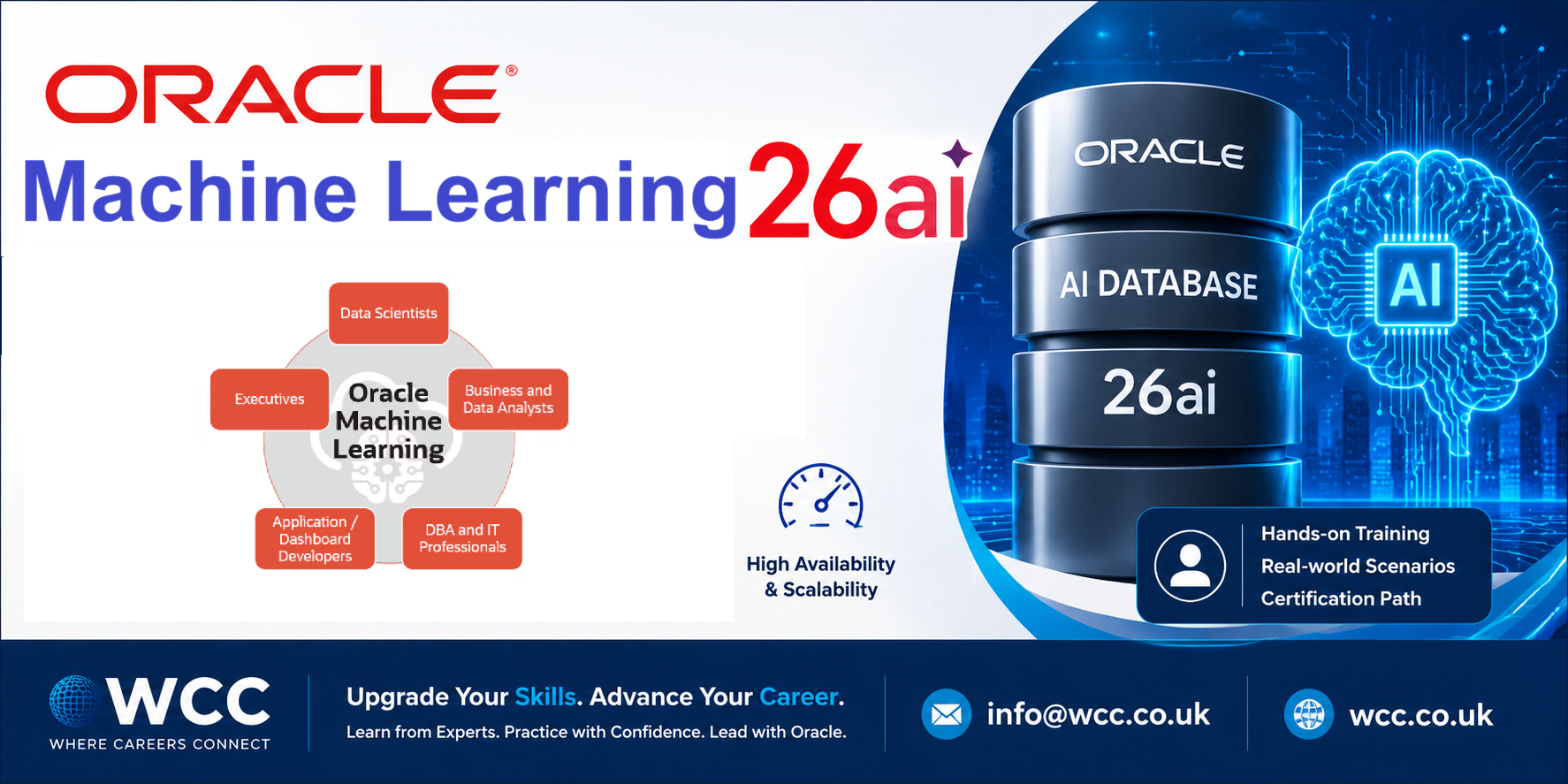
Oracle Machine Learning 26ai
6 Saturdays (9am to 11am) | Intermediate to Advanced | Course Notes
Course Content
Week 1 — Introduction to OML 26ai & OML4SQL
- Overview of Oracle Machine Learning (OML) architecture within Oracle AI Database 26ai
- Understanding in-database machine learning and its advantages over traditional ML frameworks
- Introduction to OML4SQL: building ML models using SQL and PL/SQL APIs
- Setting up OML Notebooks and connecting to Autonomous Database and on-premises environments
- Navigating the OML user interface and exploring built-in ML algorithms
- Data exploration and preparation using OML4SQL queries
- Understanding model lineage: tracking models using the
BUILD_SOURCE column in data dictionary views
- Best practices for secure and scalable in-database ML development
Week 2 — OML4Py (Python) & Advanced Data Preparation
- Introduction to OML4Py: architecture, proxy objects, and embedded Python execution
- Connecting OML4Py to the Oracle AI Database and configuring Python environments
- Leveraging the native
VECTOR data type for similarity search and feature representation
- Advanced data preparation: handling high-cardinality categorical features using the
ODMS_EXPLOSION_MIN_SUPP setting
- Scaling and normalizing large datasets for efficient model training
- Data partitioning strategies for training, testing, and validation
- Handling missing data, outliers, and feature engineering at scale
- Performance benchmarking and optimization of data preparation workflows
Week 3 — Supervised Learning: Classification & Regression with XGBoost
- Building supervised learning models using OML4SQL and OML4Py
- Implementing classification algorithms: Logistic Regression, Decision Trees, and Random Forest
- Deep dive into Extreme Gradient Boosting (XGBoost) for classification and regression tasks
- Model evaluation metrics: Accuracy, Precision, Recall, F1-Score, and RMSE
- Hyperparameter tuning and cross-validation techniques within the database
- Interpreting model results using built-in explainability features
- Model scoring and prediction using SQL and Python interfaces
- Managing model persistence and versioning in the database catalog
Week 4 — Unsupervised Learning, Time Series & Feature Extraction
- Implementing clustering algorithms: K-Means, Hierarchical Clustering, and anomaly detection
- Feature extraction using Non-negative Matrix Factorization (NMF) for dimensionality reduction
- Time series forecasting with Exponential Smoothing Method (ESM) — automatic model type and hyperparameter selection
- Using Explicit Semantic Analysis (ESA) for unstructured text: generating dense projections (doc2vec embeddings)
- Combining ESA outputs with traditional ML models to improve classification accuracy
- Handling seasonal data and forecast evaluation
- Detecting outliers and anomalies in streaming data using in-database algorithms
- Case studies: Customer segmentation and demand forecasting
Week 5 — Advanced Features: AI Vector Search & ONNX Integration
- Deep dive into the
VECTOR data type and AI Vector Search for semantic queries
- Generating and storing embeddings using OML4Py and OML4R
- Combining vector searches with traditional relational, text, JSON, and graph queries in a single SQL statement
- Exporting OML models to the ONNX (Open Neural Network Exchange) format
- Integrating ONNX Runtime for high-performance, cross-platform inference
- Implementing in-memory sharing of external initializers for ONNX models — reducing memory usage and improving scalability for concurrent workloads
- Deploying ONNX models for real-time scoring inside the database
- Performance tuning of vector indexes (HNSW) with concurrent DML operations
Week 6 — MLOps, REST Integration & Capstone Project
- Understanding the machine learning lifecycle: training, deployment, monitoring, and retraining
- Model management and lineage tracking using data dictionary views
- Deploying OML models as REST endpoints for application integration
- Integrating OML with Oracle Analytics Cloud and third-party BI tools
- Monitoring model drift and performance degradation over time
- Automating retraining pipelines using Oracle Scheduler and OML automation APIs
- Implementing security and access control for ML models and data
- Capstone Project: Build an end-to-end machine learning pipeline from data preparation to model deployment for a real-world business problem (classification, forecasting, or recommendation system)
Project: Develop and deploy a complete machine learning solution using OML4SQL and OML4Py, including data preparation, model training, ONNX export, and REST API deployment.
Starting Date: 4th July 2026
Course Fee: £2990